川畠稜輝(D3)の論文が、Physics of Fluids(top 10%ジャーナル, JCR 2024, JIF percentile: 92.7%(Physics, Fluids & Plasmas), IF: 4.3)から出版され、Editor’s Pick(編集部推薦論文)に選定されました。
気泡を多数含む液体(気泡流)中を伝わる圧力波には、液体単相中の音速より位相速度が常に小さい「低速モード(slow mode)」と常に大きい「高速モード(fast mode)」の2つの分枝が存在します (Egashira, Yano & Fujikawa, Fluid Dyn. Res., 2004)。前者は液相の圧縮性によらず存在する基本モードであるのに対し、後者は液相の圧縮性によって初めて現れるモードです。本研究では、気泡流のより厳密な定式化である二流体モデルを出発点として、多重尺度法を用い、低速・高速の両モードに対する非線形Schrödinger (NLS) 方程式を初めて導出しました。さらに、比較のため液相を非圧縮と仮定した「非圧縮モード」のNLS方程式も導出し、3つのモードを統一的に比較しました。
その結果、非圧縮近似は初期ボイド率が比較的大きいときには低速モードの良い近似となる一方、ボイド率が小さくなると低波数側で群速度が純液体の音速を上回るなど非物理的挙動を示すこと、過去に「低速モードに対するNLS」と位置づけられてきた既往理論(Kanagawa et al., J. Fluid Sci. Technol., 2010)が実は非圧縮モードに相当するものであったこと、さらに高速モードは分散係数の符号が低速・非圧縮モードと反対であり、非線形係数のボイド率依存性も顕著に異なるなど本質的に別種の性質を持つこと、を明らかにしました。
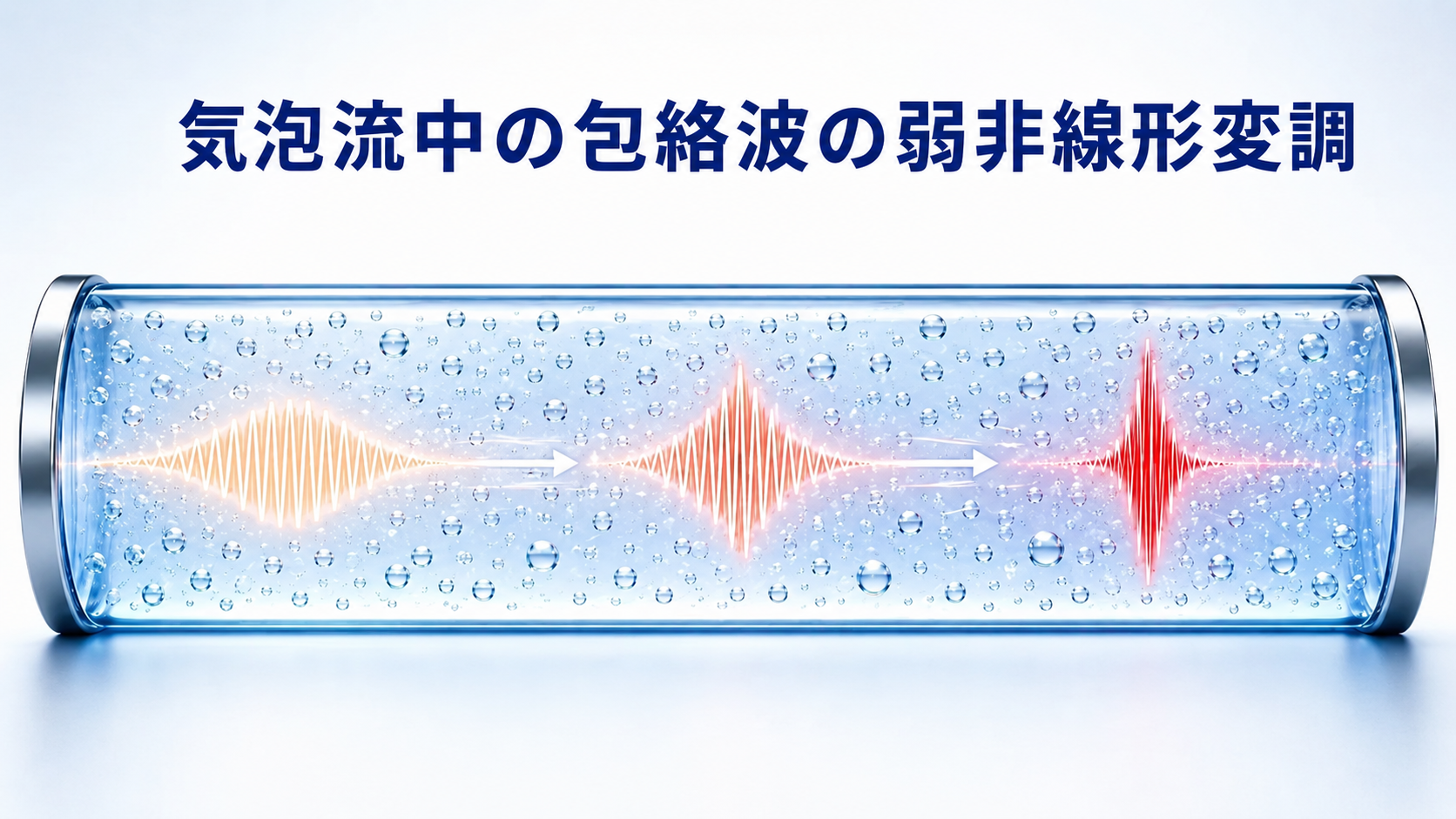
# アイキャッチ画像はChatGPTによる生成画像であり、雰囲気を伝える概念図です。論文中の図とは対応しておりません。学術的内容については論文本体をご参照ください。
A paper by Ryoki Kawahata (third-year PhD student) has been accepted for publication in Physics of Fluids (a top 10% journal; JCR 2024, JIF percentile: 92.7% in Physics, Fluids & Plasmas; IF: 4.3). The paper has also been selected as an Editor’s Pick by the editorial board.
In bubbly liquids, pressure waves are known to possess two branches: the slow mode, whose phase velocity is always smaller than the speed of sound in the pure liquid, and the fast mode, whose phase velocity is always larger (Egashira, Yano & Fujikawa, Fluid Dyn. Res., 2004). The slow mode is a fundamental mode that exists independently of liquid-phase compressibility, whereas the fast mode emerges only when the compressibility of the liquid phase is taken into account. In this study, starting from the two-fluid model, which provides a more rigorous formulation of bubbly flows, nonlinear Schrödinger (NLS) equations for both the slow and fast modes were derived for the first time by means of the multiple-scale method. For comparison, an NLS equation under the incompressible-liquid approximation (the “incompressible mode”) was also derived, enabling a unified comparison of the three modes.
The results showed that: (i) the incompressible approximation serves as a good surrogate for the slow mode when the initial void fraction is relatively large, but exhibits nonphysical behavior — such as group velocities exceeding the speed of sound in the pure liquid at low wavenumbers — when the void fraction becomes small; (ii) a previous theory that has been regarded as the NLS equation for the slow mode (Kanagawa et al., J. Fluid Sci. Technol., 2010) in fact corresponds to the incompressible mode; and (iii) the fast mode is qualitatively distinct, with a dispersion coefficient of the opposite sign to those of the slow and incompressible modes, and with a markedly different dependence of the nonlinear coefficient on the void fraction.